Artist
Interview by: Ted Kane
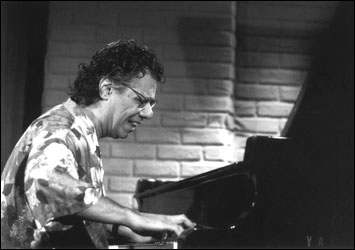 Chick Corea easily rates as one of the greatest and most
prolific artists in jazz history, whether the measuring stick is
applied to the number and quality of his recordings or to the
number of styles with which he has experimented and mastered
during his long career. In his fifth decade at the pinnacle of
jazz, Chick Corea’s recent CDs and performances show that age has
done nothing to slow him down or dull his creative abilities and
impulses. Chick’s forthcoming album on Chick’s own Stretch Records
label (an affiliate of Concord) is Rendezvous in New York.
Due on April 22nd, the release is a 2 CD live set featuring
performances from over a dozen of Chick’s friends and colleagues,
including such living legends as Roy Hanes and Gary Burton,
established stars like Joshua Redman and Christian McBride and the
brilliant young musicians in Chick’s recent groups Origin and the
New Trio. The following interview was both an honor and a pleasure
to conduct.
Chick Corea easily rates as one of the greatest and most
prolific artists in jazz history, whether the measuring stick is
applied to the number and quality of his recordings or to the
number of styles with which he has experimented and mastered
during his long career. In his fifth decade at the pinnacle of
jazz, Chick Corea’s recent CDs and performances show that age has
done nothing to slow him down or dull his creative abilities and
impulses. Chick’s forthcoming album on Chick’s own Stretch Records
label (an affiliate of Concord) is Rendezvous in New York.
Due on April 22nd, the release is a 2 CD live set featuring
performances from over a dozen of Chick’s friends and colleagues,
including such living legends as Roy Hanes and Gary Burton,
established stars like Joshua Redman and Christian McBride and the
brilliant young musicians in Chick’s recent groups Origin and the
New Trio. The following interview was both an honor and a pleasure
to conduct.
JazzReview: I guess I should start by saying how much
fun I’ve had listening to your new CD Rendezvous in New
York. It’s a really amazing collection, and it features a
really amazing collection of musicians. Why these musicians in
particular?
Chick Corea: Well first, thanks, I’m glad to hear you’re
enjoying the album. Now, the event that’s documented on
Rendezvous in New York was my 60th birthday party, mainly
which was held at the Blue Note in New York. I had a short time to
prepare for the shows—the gig was three weeks in December 2001 and
the idea came together just shortly before then. So the people
that played were my friends that were available, my treasured
musical partners who I knew and would like to play with and have
at my party.
As it worked out over the three weeks at the Blue Note, we
built up a good arrangement where different nights of each week
were given over to different types of groups. On Tuesday and
Wednesday there were duets, Thursday featured trios, and on
Saturday and Sunday, we brought in the larger groups.
JazzReview: You’ve written something about each of the
musicians that you worked with here in the liner notes, so I don’t
want to make you repeat yourself. But there are a few specific
individuals I’d like to ask you about. The first is Gonzalo
Rubalcaba. Had you worked with him before?
Chick Corea: Yeah, Gonzalo and I had just played some
duets together in Europe that summer, five concerts together at
European concert halls and we really had a blast. When I was
unable to get Herbie (Hancock) because of his prior commitments, I
immediately called Gonzalo. He was the first person I thought of
as a replacement and I was very fortunate to get him, and had an
absolutely wonderful time playing with him again.
JazzReview: It’s interesting to hear you bring up
Herbie, because he’s one of the few guys that kind of stands out
by being absent from the recording, though it makes sense that his
schedule would be pretty full. Dave Holland is another one in that
category, given all the great work you’ve done together through
the years.
Chick Corea: Right, and it was the same thing with Dave
Holland. I had actually been hoping to put Circle back together
for the gig, but Dave was so busy that he couldn’t make it. He’s
made several great records over the last few years.
JazzReview: Yeah, his recent albums have been terrific.
To kind of finish this theme, the other thing that struck me about
the current release is that all of the bands are acoustic, which
was a little surprising given your history with electric
instruments. But, before I could read anything into that, of
course, it occurred to me that you recently played some shows with
the Elektric Band.
Chick Corea: Well, there was just such a short
preparation time for the gig. I toyed with the idea of putting
Return to Forever together, but when I thought of the time needed
to put together that type of production, it just wasn’t there. So,
I basically made no attempt to do anything like that at the Blue
Note. As you mention, I recently did some shows with the Elektric
band, and we do plan to do some more work together. We have a
whole summer tour lined up.
JazzReview: Getting back to the album, another artist
involved in the Blue Note project that I’m curious about is
Miroslav Vitous. You mention in the notes that one of the reason’s
he’s kept a fairly low profile in jazz recently is that he’s been
involved in making recordings for sampling.
Chick Corea: Miroslav’s developed a whole business
recording orchestral samples, which I understand are very popular
with the people who use samples. So, he hasn’t been completely
active lately playing jazz, although that’s changing. He recently
completed a new album for the ECM label, a couple of tracks of
which I contributed to.
JazzReview: That’s certainly welcome news, and I’ll
definitely look for that one when it’s out. Your two most recent
groups are Origin and the New Trio, they’re both featured on the
new album and they both share the nucleus of Jeff Ballard on drums
and Avishai Cohen on bass.
Chick Corea: Well, the New Trio grew out of Origin.
Origin is an ensemble I put together in 1997, and it started out
really with Avishai’s bandmates--I produced Avishai’s band as the
first release on Stretch Records, and then ended up working them
into Origin--I just added Bob Sheppard and Tim Garland, and that
was Origin. I worked with those guys for a couple of years and
then did the Past, Present and Futures CD as the New Trio
with Avishai and Jeff and played with that unit for a year or two.
JazzReview: Bobby McFerrin is someone else you played
with here that I’d like to talk about. He has such tremendous
range. He performs in a very comic style on the first couple of
tracks, and then—actually, I think there’s a kind of a false
dichotomy that sometimes gets set up between “comic” and “serious”
art, because there’s a lot of seriousness behind any kind of good
comedic work, so let’s just say that here on the album he sings
really well here both comically and straightforwardly as the
situation dictates.
Chick Corea: Uh-huh. I know what you’re saying and I
agree with it. That’s a very, very good description. Bobby
McFerrin is one of the most complete artists and performers I
know. As a solo performer, what he does is unprecedented. What he
does just walking onstage by himself is incredible—he has
immaculate creative and musical technique. And he’s a unique and
amazing orchestra conductor as well. He combines his
improvisational techniques with the traditional role of the
conductor. I just saw him lead the Florida Orchestra, and it was
incredible. The program included pieces by Prokofiev and Ravel,
Bobby did some solo antics and then Beethoven’s Eighth. I was
absolutely floored.
JazzReview: Another thing that impresses me about the
album is that, while it’s ostensibly a celebration of your many
years of making music, you devote a lot of space to music by
Thelonious Monk, Bud Powell and other composers.
Chick Corea: Well, again, it was my party, and I wanted
to play music that I enjoy. The music I chose, particularly from
Monk and Bud Powell, is music that I love and have been influenced
by throughout my entire life. Monk is usually part of everything I
do, as is the music of Bud Powell. I did a trio recording of all
Monk tunes with Miroslav Vitous and Roy Haynes around 1981, and,
of course, the Remembering Bud Powell Band was one of the groups I
featured at the Blue Note and on the album.
JazzReview: I was recently looking at your website and was really
impressed. Some people seem to have a website just because they
think they ought to have one, but yours has a lot of content on it
and feels like a real destination on the web.
Chick Corea: Thanks, I’ve been trying to make the
website something special. I have a lot more ideas for it. One of
the things I really like on it is the ongoing question and answer
section I have with the people who write in. I really appreciate
the opportunity to communicate directly with my fans.
JazzReview: You’ve done so many different types of
things musically through the years, from acoustic trios, to
fusion, to concerti and so on. Do you find that you have the same
fans regardless of the type of project you are doing, or does it
vary according to the nature of the project?
Chick Corea: Well, I just have such great fans that I
play for around the world. I’m blessed with audiences of music
lovers of every category, every race, creed, color, age…I’d say
they all tend to be wonderful audiences. Now, it can be a little
unpredictable who is going to be at a place like the Blue Note in
New York, which is a world-famous jazz club and an international
spot for travelers. On any given night during the three-week run
there, probably fifty to sixty percent of the crowd were out of
towners, including people from Europe, Japan and all over the
world, which is very exciting.
JazzReview: There were also a lot of musicians in the
crowd at those gigs, some of who sat in with you. Though you are,
obviously, well known for your work in fusion, I was still a
little surprised that a few of them were artists that one tends to
associate with rock, such as Isaac Hayes—a Rock-and-Roll Hall of
Famer, in fact--and Chaka Khan.
Chick Corea: I usually pay very little attention to
styles of music. I think it’s kind of a red herring to label
musicians and performances as being any one particular thing. I
just enjoy working with different musicians, and they are both
great musicians. Isaac, I know through Scientology, we’ve played
together in the past at church events and always enjoyed playing
together. Chaka, I’ve known for quite a while. I produced her
first jazz recording back in 1983. I love her as a singer. There
was quite a bit of sitting in that went on during the gig—Wallace
Roney, George Benson, Bela Fleck and several others…Paul Schaffer
did some things that were very nice at the Blue Note.
JazzReview: Is any of that going to eventually come out?
I’d love to hear some of it.
Chick Corea: Yeah, the Rendezvous project was
really such an incredible one. We edited sixty hours of recordings
down to two hours for this album and we’re planning on a
subscription series of ten CDs and ten DVDs. We’re also planning
to broadcast some documentaries in HDTV. Each of the nine
different bands will have a release, and there will be a tenth one
that’s a compilation of everything.
JazzReview: This CD is recorded in something called
Direct Stream Digital (DSD). What exactly is that and what does it
mean for the listener?
Chick Corea: Direct Stream Digital is a brand new
digital audio technique developed by Sony and Phillips—they own
the copyright, in actual fact—that brings the sound quality of
digital up to the level of analog. Now, when CDs came out there
was lot of talk—propaganda, really—about how the sound quality was
“better” than analog, but that really wasn’t true. It was easier
to skip around from track to track, but the sound quality wasn’t
any better.
JazzReview: I’m so glad to hear you say that. When CDs
came out I remember thinking that they didn’t seem to really
“breathe,” if you know what I mean, and that it took me a while to
get used to that.
Chick Corea: I know what you’re saying, and DSD
breathes. Have you heard the album on a player equipped for DSD?
JazzReview: No, just on a regular CD player. It does
sound good, though.
Chick Corea: You’ll be amazed how good it sounds when
you hear this on a DSD player. This is actually the first
recording made with a sixteen track DSD recorder. First they had
it for two tracks, then four, then eight and—just in the nick of
time, right before the gig—they got DSD up to sixteen tracks.
JazzReview: Chick, thanks for giving us some of your
time and good luck with the album and everything else you have
going on.
Chick Corea: Thank you.
For more information: http://www.chickcorea.com/
Photo by:
© Morrice Blackwell
 Click here for printer-friendly
version of article.
Click here for printer-friendly
version of article.
 Send this
page to a friend.
Send this
page to a friend.